
FLEETWERX utilizes its ecosystem and market research to attract best-in-class submissions to solve national security problems. Subsequently, government subject matter experts review and select participants with the highest value to collaborate with for the given opportunity.
Note: All Assessment Events (AE) conductedthrough FLEETWERX have the potential to result in monetary awards and/or agreements.
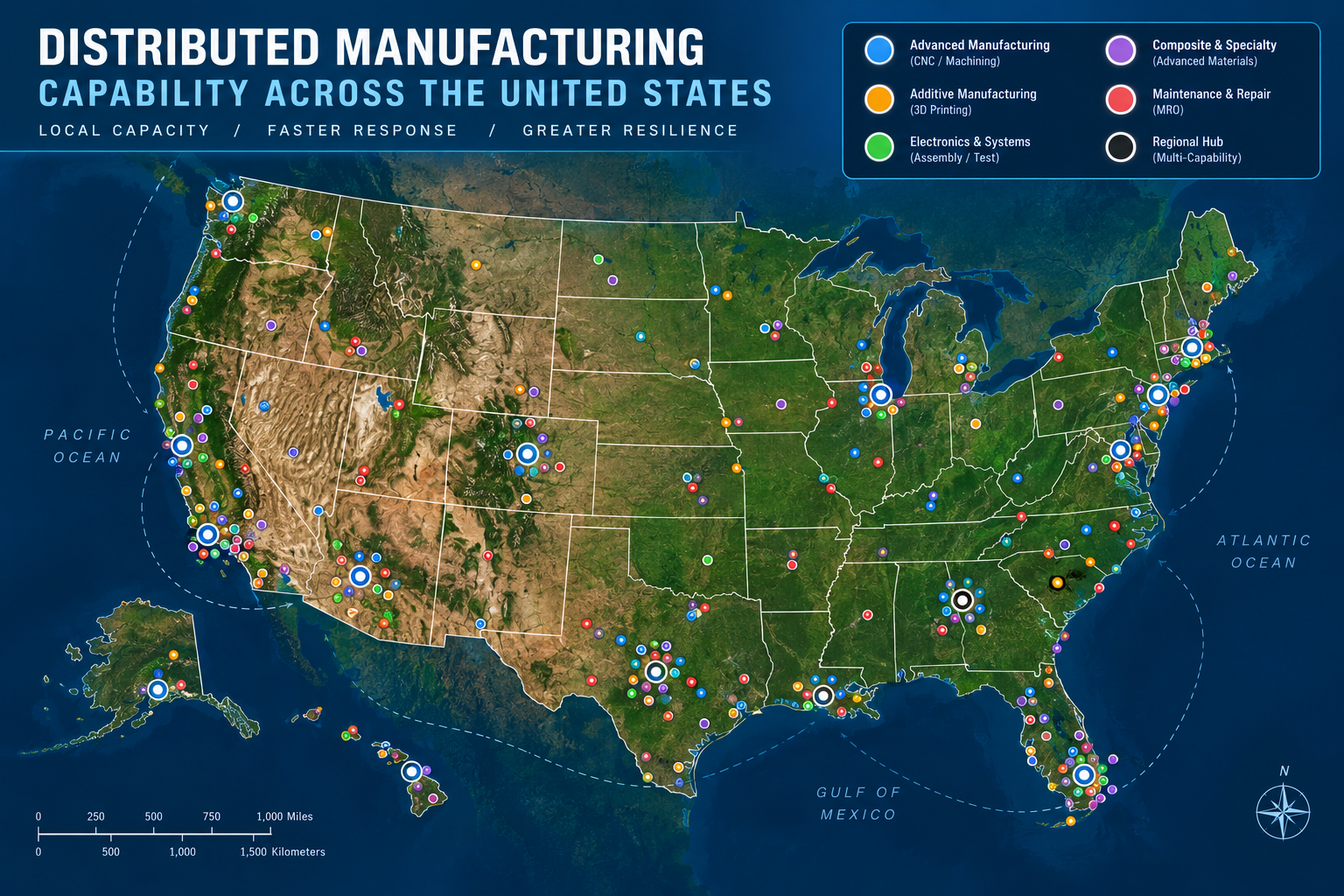
The Joint Force must maintain fleet readiness, material redundancy, and operational self-sufficiency for highly contested environments. As the Department of Defense scales the use of advanced manufacturing (reverse engineering, computer-aided design & manufacturing, machine operations, verification testing) both at the point of need and globally, methodology to rapidly and securely onboard global manufacturing capabilities is required to fulfill warfighter production needs. The Naval Postgraduate School (NPS) Consortium for Advanced Manufacturing Research and Education (CAMRE) and Defense Logistics Agency (DLA)seeks to iterate on digital networks for advanced manufacturing: mapping and onboarding advanced manufacturing capabilities across industry, military, academic, and government nodes; process-mapping and aligning those workflows to the Defense Logistics Agency's Joint Additive Manufacturing Acceptability (JAMA) framework; integrating open APIs for modular AI and manufacturing-optimization tooling; aggregating manufacturing data to identify and mitigate supply-chain bottlenecks; Impact Level 5 (IL5) compliant cloud environment; validating through a Proof-of-Concept at a large-scale exercise or a discrete operational need; real-time data analytics. This directly supports DLA AM Program's priority of accelerating AM part acceptance and capitalizing on AM digital technologies
Key System Requirements
Proposed solutions must address the following Top Level Requirements (TLRs). The system must be a secure, scalable, and adaptive digital network environment optimized for supply chain management.
Scope/Composition: Leverage the Joint Advanced Manufacturing System (JAMS) to map and onboarding advanced manufacturing capabilities across industry, military, academic, and government nodes; process-map and align JAMS workflows to the Defense Logistics Agency's Joint Additive Manufacturing Acceptability (JAMA) framework; integrate open APIs for modular AI and manufacturing-optimization tooling; aggregate manufacturing data to identify and mitigate supply-chain bottlenecks; function on Impact Level 5 (IL5) compliant cloud environment, and validate through a Proof-of-Concept at a large-scale exercise or a discrete operational need.
Mapping and Onboarding Advanced Manufacturing Capabilities: Create user friendly method to ingest vendor manufacturing and equipment information into JAMS, validate if they are Enhanced Joint Certification Program (EJCP) certified or not, and determining what type of data they are able to receive.
JAMA Framework Workflow Alignment: See DLA Additive Manufacturing Implementation Plan DoDI 5000.93 Use of Additive Manufacturing in DoD.
Open APIs: Open-architecture API framework allowing modular integration of emerging technologies to enhance JAMS.
Impact Level 5 (IL5) compliant cloud environment: Data must be able to be managed in an IL5 cloud environment.
Proof of Concept: Resulting prototype(s) shall be demonstrated in an exercise or operational environment.
Data Analytics: Real-time dashboarding for items such as resource availability and production.
Example
The lists below are examples of potential application areas and attributes of interest. We encourage creative solutions that address our challenge.
Vendor intake system: Methodology to rapidly and accurately collect manufacturer information with a two-way API for JAMS connection.
Software Engineer(s): Development of JAMS process workflows to take part request, manufacturing recipe generation, and production assignment and assist with migration to IL5 environment.
Subject Matter Experts: Ensure digital network is alignment with DoD policy and guides best practices for supply chain and manufacturing.
Evaluation Factors
The government will evaluate proposals during Steps 1-3 using the following factors:
1. Technical Merit.
2. Relevance of proposal to problem set and key requirements.
3. Price/Cost.
Questions: info@fleetwerx.org
14SEP2026 to 09OCT2026 – White Paper Submissions Open: Interested respondents who could potentially provide expertise/solutions that meet the needs of the Government Stakeholders are to submit one (1) White Paper Submission for Government only review. To submit the White Paper Submission, please follow the submission instructions bottom of this event release.
30SEP2026 1100-1200 Pacific Time – Objective Strategic Session (OSS): Potential performers have the opportunity to ask the Government Stakeholders about the desired project objectives. Government Stakeholders will provide further details in conversation.
09OTC2026, 1700 Pacific Time
09OCT2026 – 21OCT2026: Government Downselect
21OCT2026 - 30OCT2026: B2B signed
30OCT2026 - 10MAR2027: Rapid prototyping
10MAR2027 - 17MAR2027: Final Report



.png)